GM take-away: How to genetically modify a tomato, and other things we eat

GM take-away: How to genetically modify a tomato, and other things we eat

GM take-away: How to genetically modify a tomato, and other things we eat

A take-away photographic exhibition, being launched at the British Science Festival in Bradford on Saturday 10th September, is aiming to demystify the process of genetic modification, to try to make the debate about this controversial subject more informed.

The exhibition has been put together by Murray Ballard, a Brighton-based photographer, who has always had a keen interest in the environment and agriculture. It will be available for visitors to take away as a broadsheet newspaper.

The cultivation of GM crops is a subject that has divided opinion. The technology can reduce the need for protective spraying with pesticides and could improve yields, reducing the impact agriculture has on the environment. Opponents claim the technology could damage the environment or have adverse effects on health.

Within the media and on the internet, claims that GM will help solve world hunger vie with claims that it will devastate the planet, but for Murray, there was a lack of any accessible information on what genetic modification was. A recent survey showed that just 7% of people could accurately define what GM foods were. Over half of consumers neither support nor reject GM foods, and are yet to form an opinion.

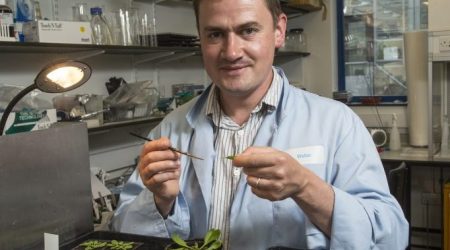
With this in mind, Murray approached the John Innes Centre, one of Europe’s leading independent centres for plant research and genetics, which is strategically funded by the Biotechnology and Biological Sciences Research Council. The centre, and the adjacent Sainsbury Laboratory on the Norwich Research Park, allowed Murray unlimited access to their laboratories to photograph the scientific processes involved in genetically modifying plants and to interview the researchers involved.

For the scientists, this is part of an ongoing effort to engage with anyone interested in GM – via public events, debate, the media and YouTube.

“When I started this project I was always thinking about who it was aimed at, and then I realised it was for me, and for people like me, who wanted to go in to these research centres and find out more,” said Murray.

During the course of his research, Murray came across a pop-up art exhibition in newspaper format. He realised that something similar would be ideal for this project. “I wanted to produce something that could be picked up and read in depth on the bus or at home,” said Murray.

He worked with designer Elliott Hammer of Birch Studio Ltd in London, to produce the exhibition so that the full display can be taken away and read as a broadsheet newspaper.

The exhibition, entitled “How to genetically modify a tomato, and other things we eat”, will be open from Saturday 10th September to Friday 15th September at the Impressions Gallery, Centenary Square in Bradford. On Tuesday 13th September (13.30-15.00), Murray and some of the scientists involved in the project will be on hand to talk about their work and answer any questions.

“How to genetically modify a tomato, and other things we eat” details the processes scientists at the John Innes Centre and The Sainsbury Laboratory are using to genetically modify plants. Three studies were followed that are producing drought-tolerant barley, blight-resistant versions of the most popular potato varieties, and healthier tomatoes. Murray recorded the different stages, showing how genes are introduced, how the plants containing this gene are checked, and then how the performance of this gene is tested.


More about “How to genetically modify a tomato, and other things we eat”:

Drought-resistant crops would be a huge benefit to farmers all around the world, battling changing climates and reducing resources. A lot of research has been carried out to understand how plants cope with drought, which at the genetic level involves a complex but coordinated response. A number of ‘master genes’ have been identified that control this response. Dr Wendy Harwood at the JIC has been using genetic modification to introduce these genes into barley, to get a clearer understanding of how they work. The exhibition depicts in a series of photographs the stages taken to introduce the genes into barley, using naturally occurring soil bacteria.

Professor Cathie Martin has produced genetically modified tomatoes that contain higher levels of naturally occurring health-promoting plant pigments called anthocyanins. The exhibition portrays the way that the scientists visualise the genes within the modified plants and the effects they have. Most strikingly, the pigments turn the tomatoes a purple colour.

The Sainsbury Laboratory is a world-leading centre in plant disease research, and has identified a number of genes in uncultivated wild South American potatoes that make them resistant to late blight. They have transferred these genes into a popular, but blight-susceptible UK potato variety, which means that it retains all of the characteristics that have made it so useful, but also with added blight resistance meaning it doesn’t need to be sprayed with pesticides. The exhibition followed the planting of the first field trial planting of these potatoes, which is designed to show how well they will cope with the populations of blight-causing organisms in the UK.


About the John Innes Centre:

The John Innes Centre, www.jic.ac.uk, is a world-leading research centre based on the Norwich Research Park www.nrp.org.uk. The JIC’s mission is to generate knowledge of plants and microbes through innovative research, to train scientists for the future, and to apply its knowledge to benefit agriculture, human health and well-being, and the environment. JIC delivers world class bioscience outcomes leading to wealth and job creation, and generating high returns for the UK economy. JIC is one of eight institutes that receive strategic funding from the Biotechnology and Biological Sciences Research Council and received a total of £28.4M investment in 2010-11.

About The Sainsbury Laboratory:

The Sainsbury Laboratory (TSL) is a world-leading research centre focusing on making fundamental discoveries about plants and how they interact with microbes. TSL not only provides fundamental biological insights into plant-pathogen interactions, but is also delivering novel, genomics-based, solutions which will significantly reduce losses from major diseases of food crops, especially in developing countries. www.tsl.ac.uk


Twitter Digg Delicious Stumbleupon Technorati Facebook Email

Comments are closed.